
One of our team members can help you buy furniture from China without visiting Foshan. We can help you find suitable pieces, speak with suppliers, check your order and coordinate shipping while you stay at home.
But if you can travel, we recommend coming to Foshan and visiting the showrooms with one of our team members. You can sit on the sofas, feel the fabrics and see the colours and finishes for yourself. Photos and video calls are useful, but they cannot tell you how comfortable a chair feels or whether a fabric is right for you.
For a small order, buying from China is not always worthwhile once you add service fees, packing, shipping and destination charges. Share your product list and destination with us first so we can help you check the overall cost before you decide.
If you cannot visit, this guide explains how to plan a remote purchase, compare quotations and approve your furniture before shipment.
Explore this guide
What to send before asking for a quote
Prepare one product schedule rather than a collection of disconnected messages. Give each item a reference code and include:
- Product type, quantity and intended room or use.
- Dimensions, drawings or reference photographs, with the details you want to match.
- Materials, finish, upholstery and hardware requirements.
- Budget range, delivery destination and preferred installation date.
- Site access restrictions and any requirements identified by your designer, installer or destination adviser.
Mark undecided choices clearly. If a supplier substitutes a material or dimension, ask for that difference to be shown in the quotation before you approve it.
Check who is supplying the goods
Ask for the supplier’s business identity, the location of production and the name of the company accepting the order. Where necessary, arrange a factory assessment or an on-site visit carried out on your behalf. A live video conversation can help you ask questions, but a video or showroom alone is not proof of ownership, capacity or product quality.
Clarify whether the seller manufactures the product, coordinates subcontractors or resells another factory’s goods. What matters for the order is knowing who is responsible for the agreed specification, inspection access, corrections and after-sales arrangements.
Compare quotations using the same specification
Ask suppliers to identify their proposed materials and packing, production estimate, delivery terms and exclusions. Compare the quotation line by line. Keep product costs separate from service fees, samples, inspections, freight and destination charges.
For example, two dining chairs with similar photographs may differ in frame construction, upholstery, finish and carton size. Record those differences before deciding whether one offer provides better value.
Approve what a screen cannot show
For colour and finish decisions, request physical fabric swatches or finish samples where practical. Review them in the room’s lighting. For seating comfort or a substantial repeat order, consider a complete sample before authorising the batch. Agree who pays for samples, packing and courier delivery.
Keep the approved sample reference, drawing version and written decision together. Ask the supplier how the approval will be used during production. If a material changes, request a new approval instead of relying on a verbal assurance that it is similar.
A simple remote approval record
Use this format for each decision. It gives both sides a record to refer to if questions arise later.
- Item: DC-01 dining chair, quantity 24.
- Reference: supplier quotation number, drawing revision and sample code.
- Decision: approved, approved with listed changes, or awaiting clarification.
- Evidence: labelled photographs, measurements or the physical sample reviewed.
- Responsibility: buyer’s approver, supplier’s contact and confirmation date.
- Next step: revised sample, production release or a scheduled check.
This is an illustrative record, not a completed client order. Apply the same format to furniture, tiles, lighting and other items in a combined purchase.
Agree checks before committing to milestones
Set the inspection scope and commercial milestones in writing before ordering. Depending on the product, checks may include an early production sample, a review of finished goods and packing checks. Ask what will be measured, how quantities will be sampled, what report you will receive and how discrepancies will be addressed.
Our quality inspection service can help compare goods with approved specifications. Photographs and inspection reports provide evidence for your decision; they do not guarantee that every unit is free of defects or replace specialist testing where required.
Coordinate collection, packing and shipping
For orders from several suppliers, confirm readiness dates before arranging collection. Review carton counts, packing requirements, item labels and the receiving address. Heavy surfaces, fragile lighting and upholstered furniture may need different protection.
Discuss consolidation and shipping with the complete product list. Confirm whether the quotation covers delivery to a port or your address, which destination costs remain payable, and who handles unloading and installation. Your appointed destination professionals should confirm import and product requirements before shipment.
Why we recommend visiting Foshan with our team
Our preferred way to help you choose furniture is to visit the showrooms together. You can try the seating, touch the materials and compare pieces in person, with one of our team members alongside you to help with suppliers and the details of your order.
If you can make the trip, read our guide to a furniture buying trip to China. If you cannot travel, we can help you buy remotely using clear specifications, samples and agreed checks. For a small order, check the full delivered cost first; the extra costs may outweigh the savings.
Frequently asked questions
Can I buy furniture for a whole house remotely?
Yes. Start with a room list, measurements and a finish palette. Use separate item codes and approvals for each room. Our whole-house buying page explains what to prepare.
Can I combine furniture and building materials?
Discuss the categories together so collection dates, packing and shipment options can be reviewed. Compatibility depends on the actual products, quantities and transport arrangements.
What if inspection identifies a problem?
Record the discrepancy against the approved specification, agree the proposed correction with the supplier and decide whether a further check is needed. Establish this process and the relevant responsibilities before placing the order.
Will buying remotely remove all risk?
No. Clear specifications, supplier checks, samples and documented decisions reduce uncertainty, but they cannot eliminate every production or transport problem.
Start with your product list
Send your room plans or buying schedule, quantities, budget range and destination. Tell us whether you can visit Foshan or need help buying remotely. Contact our team to discuss your order and check whether the overall cost makes sense for you. You can also review our hotel buying service if you are preparing room packages.
Planning your purchase
Use an online listing as the start of the enquiry
An online marketplace can help you discover a product and contact a seller. Before ordering, ask who sells the goods, who makes them, which model is quoted and where the sample and production will be checked.
Compare the current product, delivery and payment terms for the actual order. Platform badges, photographs and chat messages do not answer every question about a custom furniture specification. Keep the final dimensions, materials, finish, quantity and packing in a written order record.
Decide which work you will handle yourself
A buyer with a known supplier may need only an inspection or consolidation. A whole-house order may need supplier comparisons, samples and coordination across several factories. Tell us which parts are already organised so we can quote the support you need.
Buying remotely works best when each decision has a record. Keep the quotation, sample approval, change requests and inspection results linked to the same item codes.
Use our furniture sourcing checklists and project templates.
Buy furniture from China without visiting: a practical review plan
A remote purchase becomes easier when each review has a clear purpose. Instead of asking for more photographs whenever a question appears, decide what you need to establish and what evidence would answer it. The following approach helps you turn product messages and video calls into decisions you can use.
Choose the right kind of remote review
Different questions need different evidence. A video can show how a drawer opens. A dimensioned drawing can show whether the cabinet fits its intended position. A physical finish sample can help you judge colour beside materials already in your home. None of these replaces the others.
Sort the unresolved points before arranging a call. Keep appearance, dimensions, comfort and technical requirements in separate groups. If the important question is how a seat feels, more photographs will not settle it. You may need to try a representative sample or leave that choice for an in-person visit.
| Question | Useful evidence | What still needs care |
|---|---|---|
| Will it fit the room? | Dimensioned drawing and confirmed site information. | Check access and installation allowances with the person responsible at the destination. |
| Does the finish suit the scheme? | Labelled physical sample beside your existing materials. | A small sample may not show the full pattern or variation of a large natural surface. |
| How does it open or operate? | A live demonstration of the exact quoted model in normal use. | The display configuration must be connected to the version you are ordering. |
| What is beneath the visible finish? | Component specification and appropriate supporting material information. | A finished exterior photograph does not establish internal construction. |
| Is the finished item the one approved? | Item-linked inspection record against the current specification. | Clarify what was examined, what remained inaccessible and what still needs a decision. |
Prepare a short agenda for the video call
Send the supplier or sourcing team the item references and a few specific questions before the call. Ask them to have the relevant piece, finish samples and current drawing ready. A call spent searching for a fabric book leaves less time to discuss the actual choice.
Begin with the overall item and its identifying reference. Then work through the detail in a consistent order. For a cabinet, that could mean the exterior, side and back, internal layout, door and drawer operation, and the available finish samples. Ask the supplier to demonstrate normal operation rather than trying to judge function from a closed unit.
Where a dimension needs clarification, ask to see where the measurement starts and finishes. Distinguish an overall width from a clear opening or usable internal space. If the video connection is poor, request a labelled still photograph or a revised drawing after the call. Do not treat an indistinct view as a confirmed measurement.
End by repeating the decisions and outstanding questions. Send a short written summary with the item references. A useful summary might say that the exterior finish is selected, the internal shelf layout is still under review and the supplier must confirm a hardware detail. Each part then has a clear next step.
Use a sample pack to resolve the finish decisions
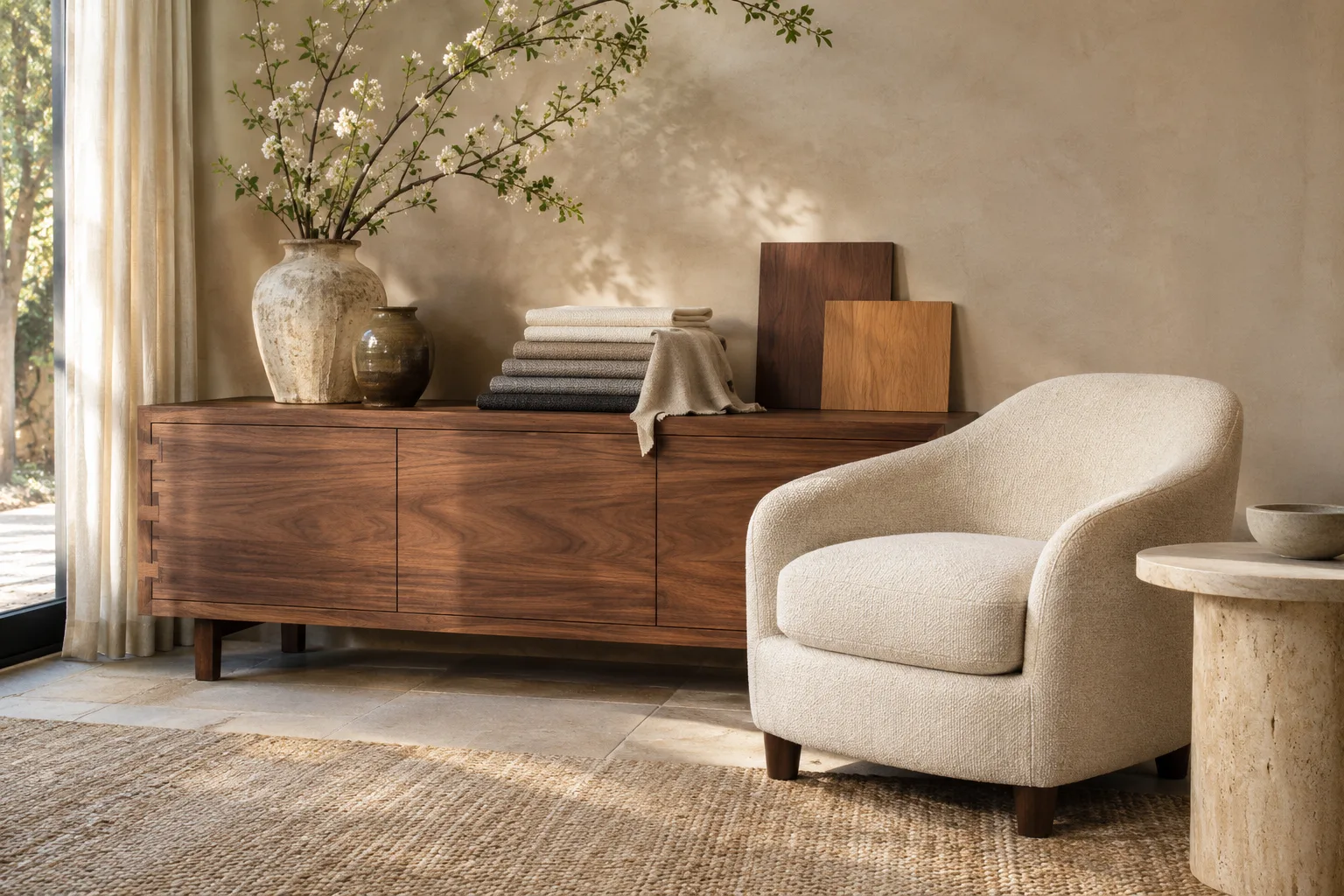
Ask for samples that represent the proposed materials rather than an unrelated presentation pack. The label should connect each swatch or finish piece to its supplier, code and intended item. If you are comparing two alternatives, keep both references visible until one is selected.
Review the pack in the space where the furniture will be used, if available. Place the samples beside the floor, wall and other fixed finishes. Look at them under the room’s ordinary lighting as well as daylight. A phone photograph can help communicate the combination, but it should not become the sole reference for an exact colour match.
When several suppliers must work around one material palette, identify the master references. Ask who will retain a matching sample and how it will be recognised during later checks. A sample labelled warm grey without a supplier code or approval reference leaves too much room for interpretation.
If the first samples do not work, explain the difference you want. More muted, less glossy or a tighter weave is a more useful starting point than simply better quality. The supplier should then propose a specific alternative for review. Keep that alternative separate from the earlier approved or rejected version.
Make it clear when a product is still an option
Remote discussions often contain several attractive alternatives. A saved photograph is not necessarily a selection, and a request for a price is not approval to manufacture. Use a small number of visible decision states so everyone understands which products are moving forward.
- For comparison: an option you want priced or reviewed.
- Preferred, awaiting detail: the likely selection, with named questions still open.
- Approved for the stated stage: accepted against a specific drawing, sample or specification.
- Replaced or withdrawn: an earlier option that should no longer guide the order.
State the stage being approved. Permission to make a sample is different from approval of the sample, and neither automatically approves a later material substitution. This matters particularly when a supplier conversation mixes photographs of catalogue products, your requested changes and progress images.
Resolve substitutions in writing
If a supplier proposes another fabric, fitting or material, ask why it is needed and which order lines it affects. Request the exact alternative and its effect on appearance, function, maintenance, timing and price. Keep it marked as a proposal until the appropriate person approves it.
A message saying something similar is fine leaves too much open. For custom pieces, attach the decision to the current drawing. The custom production guide explains how to record the change.
Review the findings that need your decision
Start with the inspection scope, products examined and unresolved findings. Separate a requested correction from evidence that it has been completed. Identify the affected goods when deciding whether an item needs another check or can proceed.
Use the quality-control service page to agree the checks, and the buyer-resource issue log to track the answers. Finished-product photographs should support the record, not replace it.
Prepare the person receiving the furniture
Send the receiving contact the current item list, package references and assembly information before dispatch. Identify the packages containing hardware and which furniture pieces belong together. The consolidation and shipping guide explains how supplier orders connect to the delivery plan.
Can someone else approve the selection for me?
Yes, if you clearly identify that person’s role and authority. A designer may approve the appearance while your installer confirms dimensions. Tell the supplier who gives the final instruction once those reviews are complete.
What if I still cannot judge an important detail remotely?
Keep that decision open. Ask for a more useful sample or specific evidence, review another product, or consider an in-person buying visit. A clear unresolved question is easier to manage than an approval based on an assumption.
When you send us your remote buying brief, tell us which items are already chosen and which decisions you need help making. That gives the first review a practical starting point.