A ceramics trip towards Nanzhuang works best when each appointment has a clear purpose. One meeting might establish the right product range; another might settle a slab layout, while a separate visit checks stock or fabrication. Visiting more showrooms does not automatically resolve those questions.
This guide connects three destinations on a western Foshan buying route: China Ceramics & Sanitaryware Industry Headquarters, the Huaxia area and Cihai International Ceramic Trading Center. It focuses on preparing useful appointments and turning a surface you like into an orderable specification. For the wider choice of destinations, start with our building-materials markets guide.
Explore this guide
Check the destination before arranging the route
English market names are not always consistent. Save the Chinese address, the supplier’s building number and a current location pin. These address references were checked on 11 November 2026; they identify the area, not a guarantee that a particular showroom will be open when you arrive.
| Destination | Address reference | What to confirm |
|---|---|---|
| China Ceramics & Sanitaryware Industry Headquarters | No. 68 Jihua West Road, Chancheng, Foshan 佛山市禅城区季华西路68号 |
Brand, building and showroom entrance. Treat this as a western Foshan stop; do not assume every appointment is in Nanzhuang. |
| Huaxia Ceramic Exposition City area | Taobo Avenue, Nanzhuang, Chancheng, Foshan 佛山市禅城区南庄镇华夏陶瓷博览城陶博大道 |
The named showroom or exhibition venue, with its building number. |
| Cihai area | No. 168 Jihua West Road, Nanzhuang, Chancheng, Foshan 佛山市禅城区南庄镇季华西路168号 |
The current business entrance and exact meeting location within the development. |
Address references: CeramBath’s official venue guide and MOREROOM’s published contact details.
Two exhibition centres need particular care. The Huaxia venue is Foshan International Conference & Exhibition Center on Taobo Avenue. The similarly named Foshan International Ceramics Exhibition Center is associated with Jihua 4th Road. They are different destinations. Compare the full Chinese address before accepting a car booking. Sources: CeramBath venue addresses and the ceramics exhibition centre’s contact page.
Use a headquarters appointment to resolve the product brief
A headquarters showroom can be a useful setting for comparing a brand’s collections and discussing a project schedule. Arrange the meeting around decisions: which finish, which available dimensions, which production option and which documents the destination team needs.
Send a short selection list before travelling. Include the intended room, approximate quantity, preferred appearance, dimensions and delivery timing. Ask the contact to confirm which requested samples will actually be available. A general invitation to visit does not confirm that the person responsible for export quotations or technical drawings will be present.
During the meeting, separate three approvals. The designer selects the appearance. The appropriate project professional confirms suitability for the intended use. The buyer agrees the commercial scope. A beautiful display alone cannot settle all three.
Also establish who will sell the material, who will manufacture or supply it, and who will undertake any fabrication. These can be different businesses. Record their roles before asking for a combined quotation.
Make Huaxia a set of named appointments
Huaxia is an area to navigate with specific supplier destinations. For example, Huiya’s own website lists its marketing centre at Taobo Avenue, Building 16: 广东佛山市禅城区南庄镇华夏陶瓷城陶博大道16座汇亚营销中心. That is the brand’s address, not a street number for the entire ceramics area. Check Huiya’s published address.
Build your visit list from products you need to see. A buyer comparing neutral floor tiles should bring the same reference samples to each appointment. Someone reviewing decorative wall panels should prioritise full displays, panel joins and available pattern faces.
If your visit coincides with an exhibition, verify the current event guide separately. An exhibition booth, a permanent showroom and a warehouse are different meeting locations. Ask whether the sample you saw at the event is an available order item, a proposed range or a special display.
At Cihai, confirm the showroom and the stock location
MOREROOM’s contact page uses a Cihai address at No. 168 Jihua West Road, Area A, Building 3. Its footer describes the address as Meili Xintiandi, West Block A3, at the same road number. The Chinese site also uses the Meili Xintiandi wording. This is a practical reason to request a live pin and entrance photograph instead of relying on an old English address. See the brand’s Chinese address.
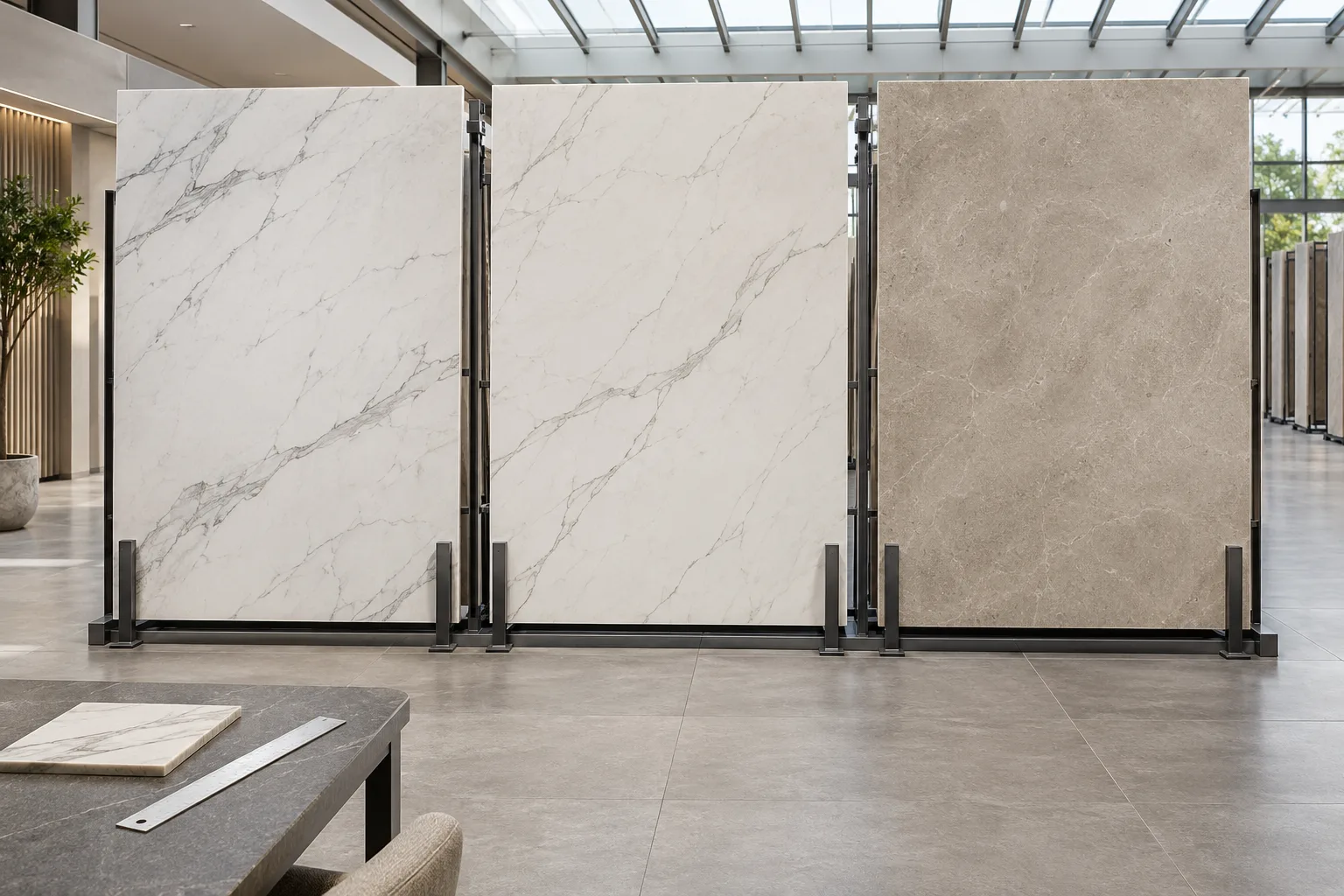
For a slab appointment, ask which full panels are on display and which actual stock can be inspected. A display may help you approve the design, but the order still needs an identified product, thickness, finish and supply batch.
Request a photo record that connects the selected surface to its product code. Include the full face and any identifying label. If several patterns or faces form a series, specify which are acceptable and whether their arrangement needs approval.
Do not assume a showroom appointment includes access to a warehouse or cutting workshop. Arrange those separately when they matter to the order.
Plan the day around decisions, not a fixed driving timetable
The following sequence is an example, not a promise that every stop fits into one day.
- First appointment: compare the shortlisted designs and reduce the choice to a manageable number.
- Second appointment: review the preferred dimensions and finish against drawings, including corners, joins and any pattern direction.
- Technical follow-up: discuss a proposed cut list with the party responsible for fabrication, or reserve a separate workshop appointment.
- End-of-day review: label samples, record rejected options and list the questions still preventing a complete quote.
Choose the driving order after you have confirmed all addresses and appointment times. Allow time for one useful conversation to run longer. A meeting that resolves a drawing detail can be more valuable than an extra showroom visit.
Full slab planning: why finished area is not enough
Suppose a project needs two decorative wall panels, each 1,100 × 1,000 mm. Their total finished area is 2.20 m². A hypothetical 2,400 × 1,200 mm slab has a gross area of 2.88 m². Comparing those two areas is a first check, but it does not prove the pieces can be produced as required.
For a simple layout exercise, assume the fabricator reserves 20 mm at every outer edge. The remaining rectangle is 2,360 × 1,160 mm. Also assume a 5 mm gap between the two panel blanks for the cut. These allowances are invented for this example and must be replaced with the fabricator’s approved requirements.
| Layout check | Calculation | Result |
|---|---|---|
| Two panels along the slab length | 1,100 + 5 + 1,100 mm | 2,205 mm, within the assumed 2,360 mm usable length |
| Panel depth across the slab | 1,000 mm | Within the assumed 1,160 mm usable width |
| Finished panel area | 2 × 1.10 × 1.00 m | 2.20 m² |
| Gross slab area | 2.40 × 1.20 m | 2.88 m² |
The rectangles fit under those assumptions. However, a vein that must continue across a joint, a damaged area, a different pattern orientation or revised edge allowances could change the layout and slab count. The unused area is not automatically a suitable spare panel.
Ask the fabricator to return a marked layout showing each piece, its finished dimensions, orientation and reference number. Confirm which dimensions are rough blanks and which are final sizes. The drawing should show cut-outs, visible edges, seams and the relationship between adjoining pieces where relevant.
For more background on the product choices, see our porcelain slabs guide. A slab’s name or thickness alone does not establish that it suits a countertop, floor or wall assembly.
What approximately should you budget for slabs?
As one public reference, I Ceramics advertises a 1,200 × 2,400 × 9 mm slab listing at US$15–35/m² FOB, with a 200 m² minimum order. The listing was reviewed on 11 November 2026. It is a seller’s advertised example, not a Huaxia or Cihai market average, an AgentFoshan quotation or evidence of the seller’s location in either venue. View the supplier catalogue reference.
Request a quotation for your actual slab count and fabrication scope. Cutting, finished edges, openings, packing, shipment and installation need their own inclusion checks. A small order may not qualify for an advertised bulk rate. Use the building-materials budget guide for the cost comparison method.
Decide whether you need a factory or workshop visit
A showroom shows the selection. A warehouse visit can help identify the material reserved for the order. A fabrication workshop appointment can address how the approved pieces will be made and labelled. A manufacturing visit answers a different question about the proposed production source.
Choose the visit that resolves your remaining uncertainty. Requesting all four without a purpose can consume a trip without improving the decision. If production capability or the proposed supplier needs examination, discuss the scope of a factory visit or supplier audit in advance.
Before dispatch, define the quality checks against the approved order and drawings. Include piece identification, agreed appearance checks, quantities and packing records. Tell the destination installer how the package labels connect to the drawing.
Leave with a decision record
The useful result of this route is a shortlist that can be quoted and checked. Keep the selected sample, product code, drawing revision, responsible supplier and unanswered questions together. Separate a preference from an approved decision.
If conventional floor tiles remain part of the same project, review the porcelain floor-tile buying guide as a separate specification exercise. Coordinate the appearance across the project while keeping each product’s dimensions, quantities and approval requirements clear.