OEM and Custom Production in Foshan

Turn your product brief into a specification that a factory can quote and produce. We coordinate custom designs, material choices, samples and production follow-up with manufacturers in Foshan and the surrounding sourcing area.
Define what needs to be customised
Custom work may involve dimensions, upholstery, finishes, hardware, product construction or branded packaging. Send drawings, reference images, quantities and the intended use of the product. Mark the features that are essential and those where alternatives are acceptable. This helps suppliers give a useful quotation instead of pricing different interpretations of the design.
Select a suitable manufacturer
We discuss the production process, minimum order quantities, available materials, sample requirements and estimated lead time with candidate factories. An existing product with a different finish can require a different supplier and budget from a new design that needs tooling or development. We help clarify these differences before you choose the manufacturer.
Develop and approve the sample
Sampling gives you a chance to review proportions, materials, colour, finish and function. We coordinate supplier questions, sample progress and your feedback. Record approved changes in the specification so the factory has one agreed reference for production. Sample costs, tooling, courier charges and revision rounds should be confirmed before development starts.
Manage changes during production
After sample approval, keep the order specification, quantity and packaging requirements in writing. If a material becomes unavailable or a design changes, request a revised quotation and schedule before accepting the substitution. Production checks can be arranged to compare the goods with the approved reference and identify deviations early.
Prepare custom goods for shipment
Custom orders need the same attention to inspection, packing and documentation as catalogue products. For project furniture, agree room labels or item references before packing. For branded goods, confirm artwork and packaging proofs. We can coordinate quality checks and consolidation as additional parts of the sourcing scope.
Common questions
Can you help with a small custom order?
Send the product and quantity first. Feasibility depends on the materials, setup work and the factory’s minimum order. We can discuss whether adapting an existing design is a practical option.
Do I need finished technical drawings?
Detailed drawings help, but you can start with measurements and reference images. Any technical development needed should be agreed with the supplier before samples or production are approved.
Agree what the sample payment buys
Before paying for a sample, confirm the item, materials, finish, delivery date and expected output. Ask whether the fee includes drawings, tooling, courier charges or a later credit against production. Record which physical sample will be retained and who holds it.
Agree permission to use drawings, artwork and other supplied design materials. A sample payment does not, by itself, settle every design right or give permission to copy a protected product.
Keep a simple change record
Give each approved drawing and sample a revision reference. For a proposed change, record the affected items, reason, price effect, timing effect and who approved it. Ask the supplier to confirm which units will use the revised specification.
Do not let a replacement fabric, hardware item or internal material become an informal substitution. Obtain the details, compare the effect on the order and record your decision.
Custom furniture sourcing: make the brief practical to produce
A custom furniture enquiry becomes much more useful when it explains how the piece will be used, which features matter and what the factory must supply. A reference image can establish a direction. It rarely explains the internal construction, the parts included or how the finished piece will enter the building.
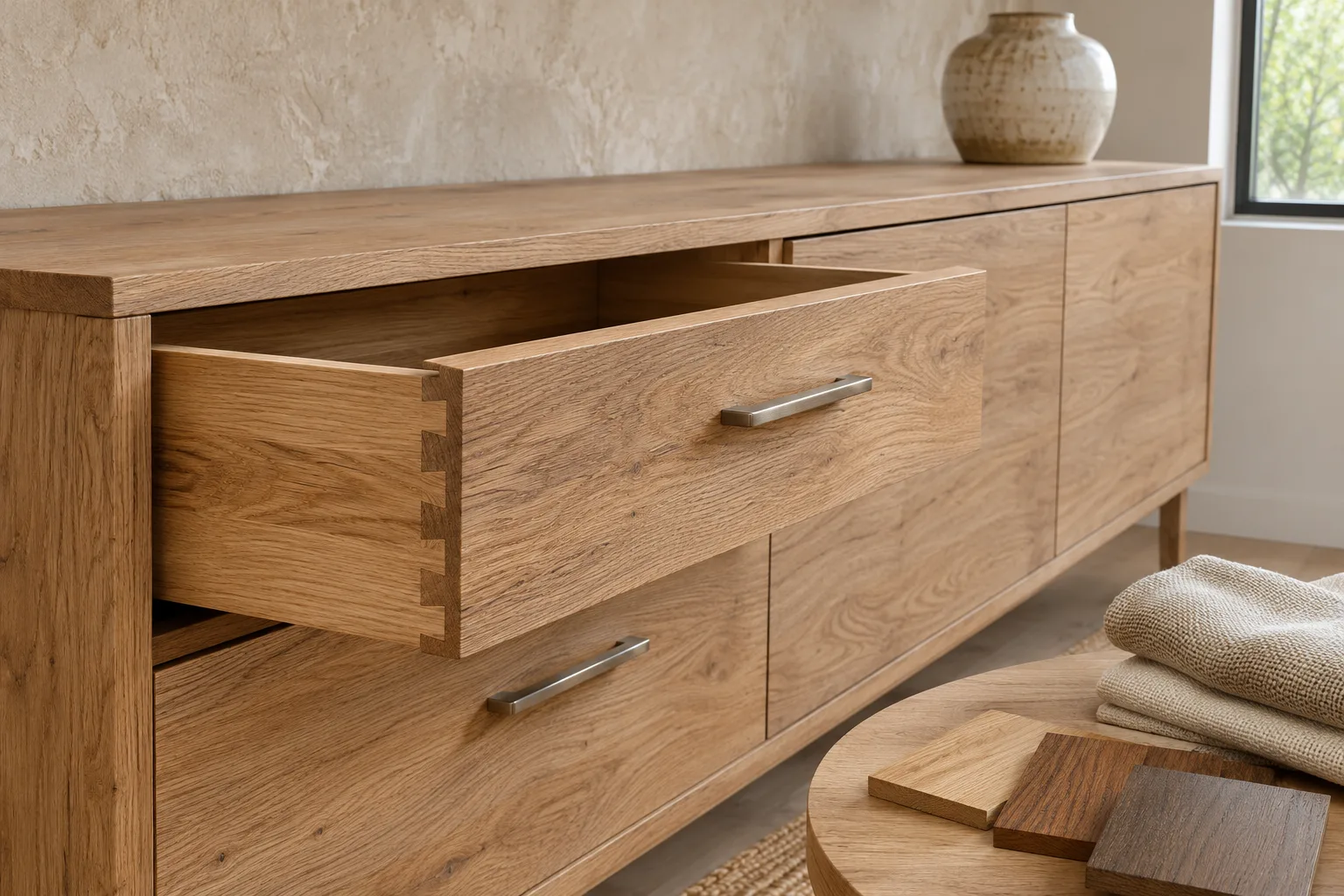
Use the next steps to develop those details with the supplier. Agent Foshan can coordinate questions, material options and production follow-up so the approved design is described clearly enough to quote and check.
Distinguish a product adaptation from a new development
Changing the fabric on an existing sofa is different from changing its frame, depth and seat construction. A longer cabinet may need a different support arrangement, while a new table base may require a separate development process. Tell the supplier exactly which parts you want to keep and which must change.
Ask whether the proposal uses an existing construction, a modified version or a new design. This affects what needs to be sampled and which questions require technical review. Compare the practical options before committing to a design that may be difficult to manufacture or move.
Build a component schedule
A single material description can leave important details open. Break the product into the parts that affect appearance, use and maintenance. Ask the supplier to identify the proposed material or component for each one, including areas that will be covered after assembly.
| Part of the product | Details to record | Useful review |
|---|---|---|
| Frame or carcass | Construction, materials, connections and relevant dimensions. | Review the proposed structure before decorative layers hide it. |
| Visible surfaces | Finish reference, sheen, grain direction and edge treatment. | Compare an actual sample under suitable lighting. |
| Upholstery | Exact covering, cushioning, seams and removable parts. | Check comfort and the areas covered by each material. |
| Moving parts | Hinges, runners, mechanisms, handles and access. | Confirm operation on a representative sample. |
| Assembly parts | Connections, supplied hardware, instructions and tools needed. | Check what the destination installer must provide. |
| Packing | Modules, protective materials, labels and largest package. | Compare the package with delivery access and handling limits. |
Identify the dimensions that control the fit
List the measurements that must work with something else: a table with its chairs, a cabinet with an appliance, or a furniture module with a lift and doorway. Ask the responsible designer or installer to confirm these dimensions and the allowances needed for installation.
Discuss acceptable variation with the supplier for the relevant dimensions. Avoid applying one general tolerance to every part without considering the material and production method. A decorative surface and a connection between fitted units may need different review criteria. Unconfirmed measurements should remain marked as open.
Review finishes as a set
When timber, metal, fabric and stone appear together, review their references together. Similar colour names do not guarantee that finishes from separate suppliers will look coordinated. Keep a labelled sample set and identify which supplier and product each sample belongs to.
For natural materials, ask what variation to expect across the order and how selection will be handled. Discuss visible faces, pattern direction and any layout approval that matters to the design. Photographs help communication, but they may not reproduce texture, colour or sheen accurately enough for the final decision.
Make assembly part of the sample review
Ask whether the product will arrive assembled, in sections or as a set of parts. Check which pieces can be removed for delivery and whether repeated assembly affects the proposed connections. Request instructions that match the actual version being supplied.
If the piece must join another supplier’s work, arrange a clear check of the connection. Record the dimensions, hardware and responsibility on both sides. Do not leave the installer to discover that a panel, bracket or fitting was assumed to be supplied by someone else.
Check the first production pieces before the whole run advances
An approved sample provides a reference, but production may introduce new questions as materials and components arrive. For a larger or more complex order, discuss whether a first production check would be useful before the remaining pieces move through the same stage.
Choose the checks around the product. It may be more useful to examine a frame before upholstery or a cabinet before final packing than to request another photograph of the completed sample. Our quality control service can be planned around the stages and access the order requires.
Keep different versions easy to identify
A custom order may include several sizes, left-hand and right-hand arrangements or more than one finish. Give each version a separate item reference and connect it to the correct drawing and quantity. Keep a clear distinction between a shared construction and a detail that applies to only one version.
Before packing, reconcile the item list with the actual modules and hardware packs. Agree labels that the receiving team can understand. Our consolidation and shipping guidance covers the records needed when custom pieces travel with goods from other suppliers.
Prepare for maintenance and repeat orders
Ask for care information and references for components that may need replacing. Keep the final specification, sample photographs and supplier model details after delivery. If you expect repeat orders, discuss whether materials and hardware are likely to remain available and what must be checked again when you reorder.
Start your enquiry with the quantity, intended use, drawings or reference images and destination. Highlight essential details and acceptable alternatives. The sample approval and project checklists can help you organise the information before development begins.
Keep the sample and the production order aligned
Custom work often changes through several conversations. A finish selected in one message and a dimension revised in another should come together in a single reference before production follows them.
Give the version a name
Record the item code, drawing revision and sample reference. Include the approval date so everyone can distinguish the current instruction from an earlier option.
Describe approval with changes
If you like the sample but want a different leg, seam or finish, list those changes explicitly. Agree how the revised details will be confirmed.
Keep substitutions separate
If the factory proposes another material or component, ask how it affects appearance, function, price and timing. Record your decision before treating it as approved.
Use the final approved reference when arranging the product checks included in your order.
Prepare the inspection reference
Details are easier to resolve around the drawing.
Dimensions, finishes and the way a piece will be used need a clear reference. Supplier discussions and your approvals help turn the design into instructions the workshop can follow.
What are you approving at each stage?
A custom piece may look right before all of its details are ready. Record each decision separately so a colour approval does not become permission to manufacture a design whose construction is still being discussed. This review table can sit beside your item schedule.
| Review | Decision to record | Question that may remain open |
|---|---|---|
| Drawing | Dimensions, arrangement and the exact revision accepted. | Has the designer or installer checked the site measurements and connections? |
| Material sample | The identified material, colour, texture and finish. | How will variation across a larger surface or a complete set be reviewed? |
| Prototype | The features examined, accepted details and changes still required. | Does the reviewed piece use the components intended for the order? |
| Intended use | Where the item will be used and the requirements supplied by your project team. | Is separate technical advice or testing needed before purchase? |
| Assembly and packing | How the item separates, the parts supplied and the agreed labels. | Who receives, assembles and fixes it in place at the destination? |
Name the person responsible for each decision. Our team can help gather the supplier’s answers and keep questions moving; design approval, site measurements and specialist technical decisions should reach the people responsible for them.
Give the prototype a practical review
Write a short review list before the sample is presented. For seating, consider the intended table height, cushion arrangement and access for cleaning. For a cabinet, consider what it needs to hold, how the doors open beside other furniture and whether a removable panel remains accessible after installation.
Ask the factory to explain any temporary component in the prototype. A sample handle, fabric or mechanism may have been fitted while the ordered version is unavailable. Record that difference and agree how the final component will be reviewed.
If a revision affects another part, review the connection too. Changing a seat cushion can affect the seating position. Changing a drawer layout can affect the hardware or internal clearances. The next approval should cover the changed detail and the parts it influences.
Keep the final handover with the goods
Before packing, ask which records the receiving team needs. The agreed handover may include:
- The final item list, with each module connected to its package label.
- Assembly instructions and photographs of connections that will be hidden when packed.
- A hardware list identifying included fittings, spare parts and anything supplied locally.
- Care information and the supplier references for replaceable components.
- Any accepted variation or remaining action, assigned to the person handling it.
Share this information before delivery so the installer can raise questions while the supplier still has access to the piece. Discuss the required records when arranging consolidation and shipping.
Can one sample cover several sizes or versions?
Sometimes it can represent shared materials or construction, but it may not answer every question about another size. Identify what carries across and what needs its own drawing, component check or sample. Ask the manufacturer to explain how the variation changes production before treating it as approved.
Discuss your custom product
Send your product list, supplier details if available, quantities and delivery destination. We will review the requirements and confirm the scope, fees and next steps for your project.